
Seven cases where you should buy from someone else: functional safety, guaranteed determinism, IEC 61131-3 specs,...
Latest posts
-
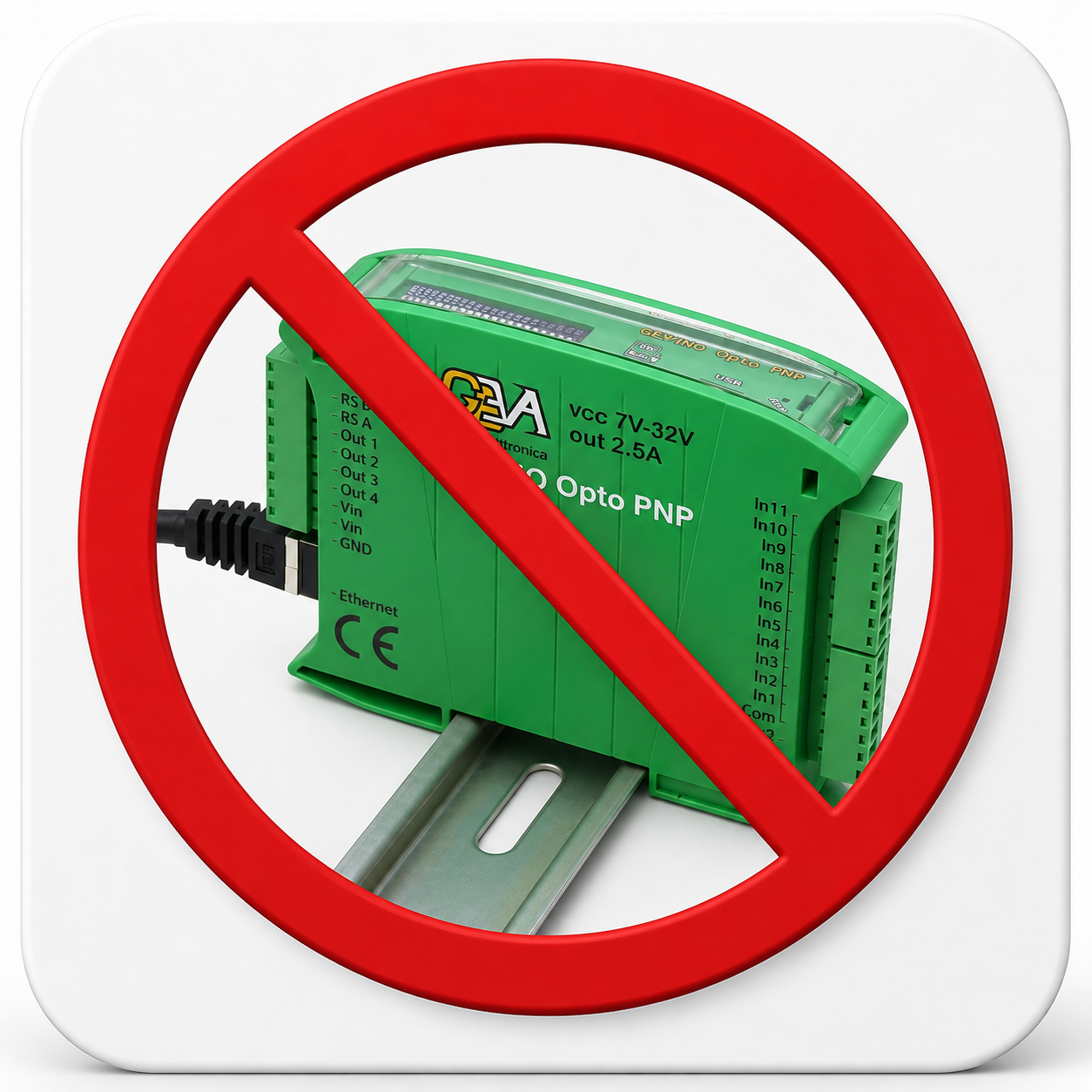 When NOT to use a GEVINORead more
 -
 Da Ladder e testo strutturato a GEVINO con l'aiuto dell'IA: costi ricorrenti a confronto, cosa si converte davvero, cosa non si converte, e la sequenza di migrazione a rischio più basso.Read more
The logic of a small machine fits on one printed page and has not changed in ten years. The bill of materials changes...
-
 Alarm Handling and I/O Monitoring: PLC Safety Logic Without Writing a Line of CodeRead more
"Artificial intelligence only writes toy examples": it is the most common objection, and it is fair. So we gave it...
-
 Industrial Retrofitting and Modbus RS485: Get Old Machines Onto the Network Without Losing Your MindRead more
There is a press from 1998 in the corner of the shop floor: it works perfectly and has no idea what Industry 4.0 is....
-
 From Idea to PLC Code in 2 Minutes: AI Writes a Conveyor Belt's Control LogicRead more
A photocell, a belt, a red lamp. Until recently, turning that description into a working program took a skilled...
-
 Arduino Is Not Industrial? Let's Clear Up the MisconceptionsRead more
Many engineers believe Arduino is suitable only for hobby projects. In reality, industrial reliability depends on...
-
 How to Program a PLC with Artificial Intelligence in 2026Read more
Discover how Artificial Intelligence is transforming PLC programming. Learn how ChatGPT, Claude Code, and...
-
 Why Choose GEVINO Instead of a Traditional PLC?Read more
GEVINO challenges traditional PLCs with lower costs, no software licenses, AI-assisted programming, and maximum...
Blog categories
Search in blog
Archived posts
Da Ladder e testo strutturato a GEVINO con l'aiuto dell'IA: costi ricorrenti a confronto, cosa si converte davvero, cosa non si converte, e la sequenza di migrazione a rischio più basso.
The logic fits on one page. The bill of materials does not.
A micro-PLC on a small machine typically handles eight inputs, four outputs, a couple of timers and a fault lamp. The logic fits on one printed page and has not changed in ten years.
The bill of materials, on the other hand, changes every year: CPU, expansion module, programming cable, software licence, support contract to keep the licence alive.
On the hardware side the substitution is uncontroversial: a 32-bit ARM processor with opto-isolated inputs and protected outputs is not the weak link in the chain. The question everybody asks is a different one, and a fair one: what happens to the program we already have?
Short answer: today you paste it into an artificial intelligence and read what comes back. Let us look at what that really means — including the parts that do not convert.
What you are paying for, line by line
Let us take an honest inventory of a small control system built on a traditional micro-PLC.
| Item | Traditional micro-PLC | GEVINO |
|---|---|---|
| CPU and I/O for around 11 inputs and 4 outputs | dedicated CPU, often plus an expansion module | a single board, I/O included |
| Programming software | licensed, per seat, sometimes per version | free |
| Annual maintenance and updates | subscription | no subscription |
| Communications (Modbus, Ethernet) | optional module, sometimes with a protocol licence | RS485 on board; Ethernet, Wi-Fi, radio and modem as supply options |
| Operator panel | on many platforms you pay per displayed variable | a web page served by the board, or a GEVINO TFT |
| Lifespan of the tools | tied to the manufacturer's support policy | programs in plain text, kept in your own archive |
The cost that really hurts is the recurring one. On a machine built in series, every unit shipped carries a slice of licensing, and every technician who touches it needs their own authorised seat.
The argument that has nothing to do with money
There is a second reason, and after a few years it weighs as much as the first.
A proprietary project is a file your company cannot read except with the software of whoever sold it to you. You cannot compare two versions to see what changed. You cannot have it reviewed by a colleague who does not hold the same licence. You cannot hand it to an artificial intelligence.
A GEVINO program is text. The moment the source is text, everything modern software has done for twenty years becomes available to you: archiving with a full history of changes, peer review, version comparison, AI-assisted rewriting. Your company's know-how stops being held hostage by a file format.
What actually needs converting
A migration is never "the whole program at once". It splits into three layers, and only the middle one is interesting.
- The input and output map. The old PLC's address codes become input 1, output 1, exactly as printed on the terminal strip. It is mechanical, and the easiest thing in the world to get wrong: it has to be written down, terminal by terminal, before generating any program at all.
- The logic. Ladder or structured text, translated into the language of the new board. This is where artificial intelligence does its best work.
- Communications and the operator panel. Usually rebuilt rather than translated — and in the rebuilding you almost always gain something that was not there before.
The test: real logic pasted into the assistant
We took a genuine routine, the kind that has been running on a machine for twenty years: dry-run protection for a pump. Start, stop, level probe, motor overload, alarm lamp. Fewer than fifteen lines in the old PLC's language.
We pasted it exactly as it was, adding a single sentence to the request:
"This is the logic of a micro-PLC. Port it to GEVINO following the board's documentation. If anything in the original logic looks wrong or ambiguous to you, tell me instead of quietly correcting it."
That last sentence is the most important one in the whole migration. Without it, an assistant will silently "improve" your logic and hand you a program that behaves differently from the machine currently running in production.
What came back
The translated program, commented line by line, in a few seconds. And, more importantly, three observations — all of them legitimate.
- There was a real defect in the original logic. After a dry-run alarm, if the operator keeps the start button pressed the pump restarts by itself: it runs dry for another ten seconds, alarms again, and so on indefinitely. It is the kind of defect that survives twenty years because it only shows up when somebody keeps a finger on the button. The assistant spotted it, corrected it and — this is the part that matters — declared that it had.
- The polarity of the stop button. A stop button is wired with a normally-closed contact, for safety reasons: at rest the signal is present, and the absence of the signal means either "pressed" or "broken cable". The translation made that convention explicit in the program instead of leaving it implicit in the wiring. Get it backwards and you have a pump that will not start — or worse, one that will not stop.
- The stop button also doubled as the alarm acknowledgement, as in the original. Acceptable on a small machine, but worth deciding consciously before carrying it forward for another twenty years.
An assistant that had quietly "cleaned up" all three would have been far less useful than one that lists them. And it is worth noting the hidden return in this story: the migration paid for part of itself by uncovering a defect that had been in production for twenty years.
What does not convert — and should not
On this subject, credibility is earned by saying the uncomfortable part too.
- Certified safety functions. Emergency stops, light curtains, guard interlocks, two-hand controls. If the application needs a certified safety function, it needs a safety module or a safety PLC, wired in hardware. GEVINO is a control PLC, not a safety PLC — exactly like the micro-PLC you are replacing, for that matter. A safety chain does not get migrated into software of any kind.
- Editing the program with the machine running. Several traditional platforms let you change the logic without stopping the process. GEVINO requires a program download — from USB, from a memory card or remotely — and therefore a stop. On most small machines this is irrelevant. On a continuous process it may be decisive, and it has to be assessed up front.
- Redundant CPUs and hot-swappable modules. Not available, and not the product class GEVINO belongs to.
- Proprietary function blocks. A drive-specific or weighing-specific block does not come across. What comes across is its behaviour, rebuilt over serial communication or analogue inputs.
- Specifications that mandate a brand. If a customer prescribes a specific manufacturer, that is a commercial constraint, not a technical one, and no conversion will solve it.
Everything else — sequences, timers, counters, interlocks, recipes, alarms, logging, operator panel — converts. And along the way it almost always gains something.
A migration that will not embarrass you
The order of steps that keeps the risk lowest:
- Write the terminal map first, one by one: voltage, polarity, contact type, load type. Have the electrician countersign it. Most failed migrations die on a wiring assumption, not on a logic error.
- Translate the logic literally, defects included, noting every deviation the assistant proposes.
- Test it on the bench, with switches and lamps on the terminal strip, comparing the behaviour against the documented behaviour of the original program.
- Run both systems in parallel if you can: the GEVINO reading the same sensors, outputs disconnected, and compare the results.
- Only then apply the improvements: fix the defects that surfaced, add the diagnostics, add the network connection you never had.
- Archive everything, including the description of the machine. The next modification — by a colleague or by an artificial intelligence — will start from a project that explains itself.
In short
Converting the program of a small machine from a traditional micro-PLC to GEVINO is no longer a rewrite: it is a translation, and the translator works in seconds.
What you gain is not only the licence cost. It is a control program written in a form your whole company can read, archive, review and evolve — in ten years' time as well, and with tools that do not exist yet. And it runs on hardware built for an electrical cabinet: opto-isolated inputs, protected outputs, DIN rail, screw terminals, RS485, with Ethernet, Wi-Fi, radio, cellular modem and CE certification available on request.
The logic on that printed page has not changed in ten years. Where it runs, and what it costs you every year to keep it alive, certainly can.
GEVINO PLCs are designed and manufactured in Italy by GEVA Elettronica.
Browse the models in our online shop, or write to email@gevaelettronica.it: send us your machine's logic and we will tell you whether and how it converts.
Posted in:
GEVINI
Related posts
-
Why Choose GEVINO Instead of a Traditional PLC?
GEVINO challenges traditional PLCs with lower costs, no software licenses, AI-assisted programming, and maximum...Read more
-
How to Program a PLC with Artificial Intelligence in 2026
Discover how Artificial Intelligence is transforming PLC programming. Learn how ChatGPT, Claude Code, and...Read more
-
Arduino Is Not Industrial? Let's Clear Up the Misconceptions
Many engineers believe Arduino is suitable only for hobby projects. In reality, industrial reliability depends on...Read more
-
From Idea to PLC Code in 2 Minutes: AI Writes a Conveyor Belt's Control Logic
A photocell, a belt, a red lamp. Until recently, turning that description into a working program took a skilled...Read more
-
Industrial Retrofitting and Modbus RS485: Get Old Machines Onto the Network Without Losing Your Mind
There is a press from 1998 in the corner of the shop floor: it works perfectly and has no idea what Industry 4.0 is....Read more
Leave a comment