
Seven cases where you should buy from someone else: functional safety, guaranteed determinism, IEC 61131-3 specs,...
Latest posts
-
 When NOT to use a GEVINORead more
 -
 Da Ladder e testo strutturato a GEVINO con l'aiuto dell'IA: costi ricorrenti a confronto, cosa si converte davvero, cosa non si converte, e la sequenza di migrazione a rischio più basso.Read more
The logic of a small machine fits on one printed page and has not changed in ten years. The bill of materials changes...
-
 Alarm Handling and I/O Monitoring: PLC Safety Logic Without Writing a Line of CodeRead more
"Artificial intelligence only writes toy examples": it is the most common objection, and it is fair. So we gave it...
-
 Industrial Retrofitting and Modbus RS485: Get Old Machines Onto the Network Without Losing Your MindRead more
There is a press from 1998 in the corner of the shop floor: it works perfectly and has no idea what Industry 4.0 is....
-
 From Idea to PLC Code in 2 Minutes: AI Writes a Conveyor Belt's Control LogicRead more
A photocell, a belt, a red lamp. Until recently, turning that description into a working program took a skilled...
-
 Arduino Is Not Industrial? Let's Clear Up the MisconceptionsRead more
Many engineers believe Arduino is suitable only for hobby projects. In reality, industrial reliability depends on...
-
 How to Program a PLC with Artificial Intelligence in 2026Read more
Discover how Artificial Intelligence is transforming PLC programming. Learn how ChatGPT, Claude Code, and...
-
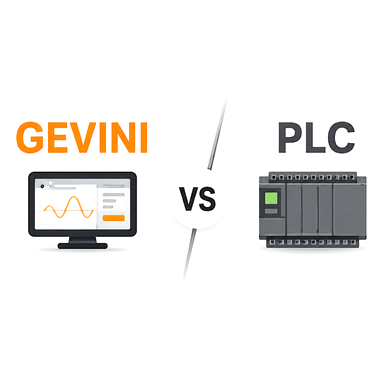 Why Choose GEVINO Instead of a Traditional PLC?Read more
GEVINO challenges traditional PLCs with lower costs, no software licenses, AI-assisted programming, and maximum...
Blog categories
Search in blog
Archived posts
From Idea to PLC Code in 2 Minutes: AI Writes a Conveyor Belt's Control Logic
The conveyor belt you program by describing it
At the far end of the shop floor there is a conveyor belt. A photocell sees the part arrive, the belt starts, the part moves along. If something jams, the belt has to stop and a red lamp has to come on.
It sounds trivial. And yet, until recently, turning those three sentences into a program that actually runs inside an electrical cabinet took a skilled technician half a day. Today it takes fifteen minutes — and the only thing written by hand is the description you have just read.
This article is that test, stopwatch in hand.
Where the time really goes
Anyone who programs machines knows it: the interesting part — the production cycle, the timings, the logic of the machine — is maybe twenty per cent of the job. All the rest is scaffolding, the same on every plant:
- filtering the signals coming from the field, because an electrical contact "bounces" for a few thousandths of a second and has to be ignored, otherwise a single part looks like fifteen;
- counting the seconds without ever freezing the rest of the program;
- handling the alarm properly: it must stay on until somebody acknowledges it, not switch itself off the moment the problem disappears;
- leaving a record of what happened, because in six months somebody else will open that cabinet.
None of it is intellectually demanding. It is simply hours. Hours paid for on every machine, and hours that have to be right — because a forgotten filter does not show up in the workshop. It shows up at the customer's site, on a Friday afternoon.
Yesterday's method and today's
Here is the comparison for this exact logic — a belt with jam detection — carried out by a technician who already knows the platform.
| Step | Traditional PLC | GEVINO + artificial intelligence |
|---|---|---|
| Install and license the programming software | 30–60 minutes, plus the licence key | none: the tools are free |
| Create the project and configure the CPU and modules | 15 minutes | none: the board is already defined |
| Write the logic | 45–60 minutes | about 2 minutes to write the request and read the answer |
| Add filters, alarms and diagnostics | 20–30 minutes | already included |
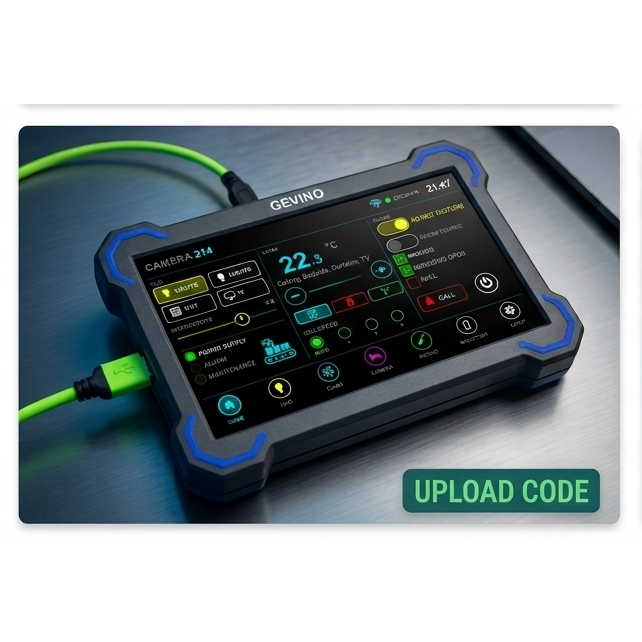
| Load the program onto the machine | 5 minutes | 5 minutes |
| Total | around 2 hours 30 | around 15 minutes |
The saving does not come from the artificial intelligence "being clever". It comes from two line items disappearing: setting up the project, and re-typing by hand what has already been written a hundred times.
The test: what we asked for
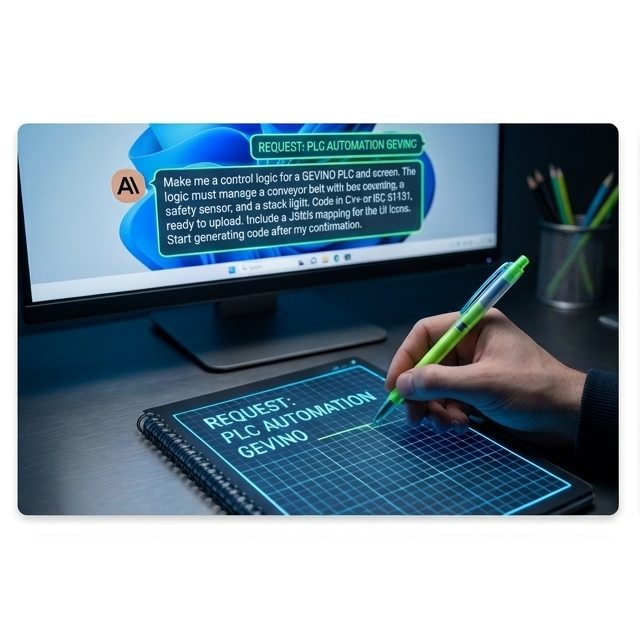
This is the request, word for word, written in plain English exactly as you would say it to a colleague:
"Generate the program for a GEVINO PLC that runs a conveyor belt with the photocell on input 1, the jam sensor on input 2 and the motor contactor on output 1. If the photocell detects a part, run the belt for 5 seconds. If the jam sensor stays active for more than 2 seconds, stop everything and switch on the alarm lamp on output 2."
That is all of it. No drawing to attach, no manual to look up, no part codes to remember.
What you never need to know
Look at the words used: input 1, output 1. They are exactly the labels printed on the PLC's terminal strip — the same ones the electrician finds on the cabinet drawing. On a GEVINO they are also the names used inside the program.
That means there is a single vocabulary, from the electrical cabinet all the way to the request you type. Whoever writes the specification does not have to know the electronics behind the terminal, or how the isolation circuit is built: input 1 active means the sensor has seen something. Full stop.
It is also the reason the artificial intelligence does not miss the target. Every GEVINO PLC comes with a document, published in its public repository, written specifically to be read by AI assistants: it describes the terminals, the rules to follow and the mistakes not to make. The assistant has nothing to guess. That is the difference between a generic program, written for some board or other, and a program written for your cabinet.
What the artificial intelligence delivered
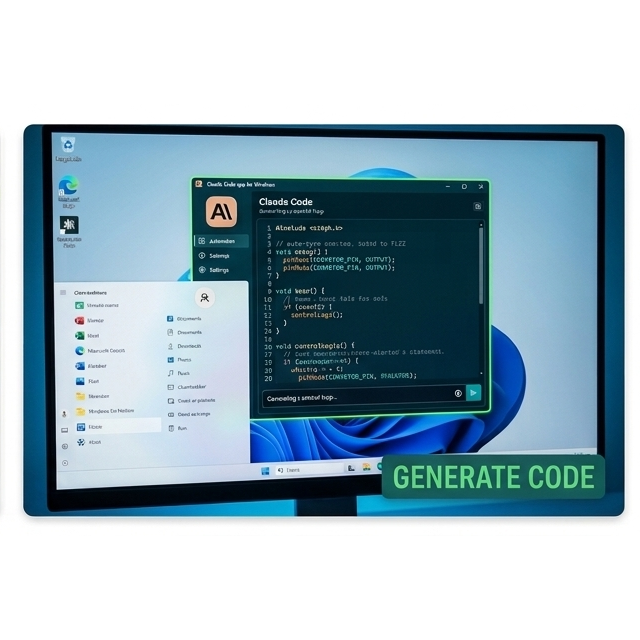
In a little over two minutes the complete program came back, commented line by line, ready to load onto the PLC. Without getting technical, here is what it does:
- It starts the belt only for a real part. Electrical noise and contact bounce are filtered out: a signal has to last at least a few thousandths of a second to be taken seriously.
- It counts the 5 seconds of running time without ever freezing the rest of the program — and if another part arrives meanwhile, it extends the run instead of cutting it short.
- It watches for a jam. The alarm only trips after 2 uninterrupted seconds: a sensor brushed by a passing part does not stop production.
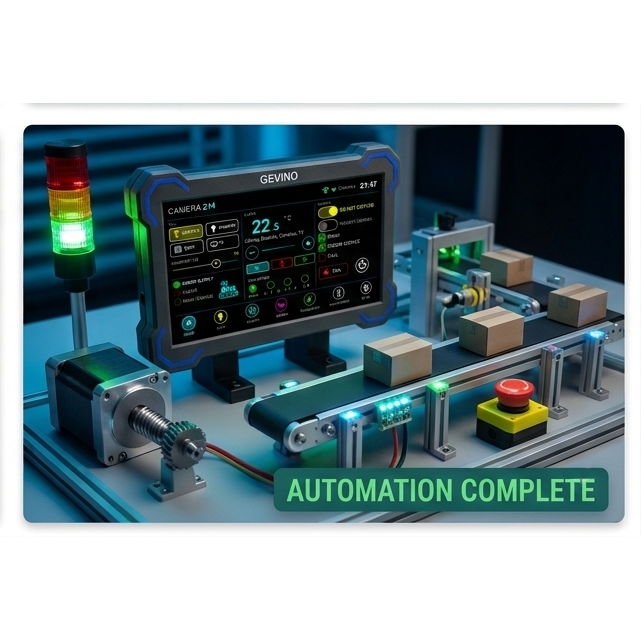
- In alarm it makes the machine safe. It cuts power to the motor and switches on the red lamp.
- It keeps the alarm on until an operator resets it with a push-button, and only once the jam has actually been cleared. An alarm that switches itself off is not an alarm — it is a flicker nobody sees.
- It keeps a log readable from a computer connected to the PLC: "part detected", "run time elapsed", "alarm: belt jammed", "alarm reset". In six months, whoever opens that cabinet will understand what happened.
One point deserves a mention: the reset button was not in the request. The artificial intelligence proposed it — and said so explicitly, instead of slipping it in quietly. That is the right behaviour: the decision stays with the engineer.
What is left to the human
Two minutes to generate, and then the part no artificial intelligence takes away: reading and understanding the program.
The questions to ask are always about the process, never about software. Is five seconds the right time for that belt? Should a second part arriving mid-run extend it, or restart the count? Should the alarm also stop the machine upstream? Those are decisions for whoever knows the plant — and changing them means changing a number, not rewriting the program.
The boundary deserves to be just as clear: emergency stops, light curtains and guard interlocks are not programmed, neither by hand nor by artificial intelligence. They are certified safety functions and they stay wired in hardware, exactly as on any traditional PLC.
Why it works
The credit does not go to the AI model alone. It goes to the fact that the GEVINO ecosystem is readable: programs in plain text, documentation written for machines as well as people, and millions of Arduino examples already familiar to every assistant on the market. A project locked inside a proprietary format, by contrast, gives an artificial intelligence nothing to work with.
Underneath, though, the hardware is still the kind that belongs in an electrical cabinet: opto-isolated inputs, short-circuit-protected outputs, protection against electrical interference, industrial screw terminals and DIN-rail mounting. With Ethernet, Wi-Fi, Bluetooth, real-time clock, cellular modem and CE certification available on request.
The result: on standard routines, development time drops by around 70%. Two and a half hours become a quarter of an hour, and the saving lands exactly where the value was lowest.
Automation has not become easier. Getting there has become faster.
GEVINO PLCs are designed and manufactured in Italy by GEVA Elettronica.
Browse the models in our online shop, or write to email@gevaelettronica.it and we will help you work out which one suits your machine.
Posted in:
GEVINI
Related posts
-
Why Choose GEVINO Instead of a Traditional PLC?
GEVINO challenges traditional PLCs with lower costs, no software licenses, AI-assisted programming, and maximum...Read more
-
How to Program a PLC with Artificial Intelligence in 2026
Discover how Artificial Intelligence is transforming PLC programming. Learn how ChatGPT, Claude Code, and...Read more
-
Arduino Is Not Industrial? Let's Clear Up the Misconceptions
Many engineers believe Arduino is suitable only for hobby projects. In reality, industrial reliability depends on...Read more
-
Industrial Retrofitting and Modbus RS485: Get Old Machines Onto the Network Without Losing Your Mind
There is a press from 1998 in the corner of the shop floor: it works perfectly and has no idea what Industry 4.0 is....Read more
-
Alarm Handling and I/O Monitoring: PLC Safety Logic Without Writing a Line of Code
"Artificial intelligence only writes toy examples": it is the most common objection, and it is fair. So we gave it...Read more
Leave a comment